
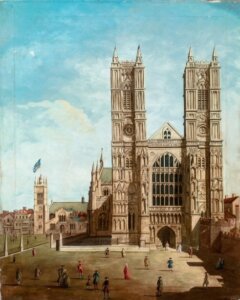
Canaletto, c.1750s
Our tour was arranged by BACSA Chairman, Paul Dean, and led by Dr Jennifer Howes, whose book ‘The Art of a Corporation – The East India Company as Patron and Collector, 1600-1860’ (Routledge, 2023) has recently become available in both paperback and Kindle editions.
This post describes our tour of the EIC memorials in Westminster Abbey. A future post will cover our visit to the India-related memorials in St Paul’s Cathedral.
By the mid-18th century, when Westminster Abbey – the site of royal burials since 1245 – began displaying memorials commissioned by the East India Company, it already housed numerous monuments to famous forbears. Visitors poured in to ‘the most popular and longest established public exhibition space in London’, to view this ‘de facto Valhalla’.
And still they come! About 3 million a year. Steering our group through the excited mêlée of 21st century visitors, Jennifer selected four 18thc EIC memorials, and explained how their dimensions, location, materials and iconography contributed to the subtle (or, in some cases, blatant) messages the Company wished to convey, in the context of their time.
1763: Vice-Admiral Charles Watson (1714-1757)
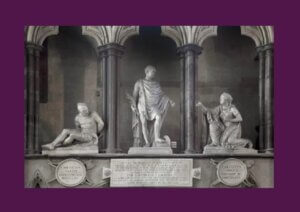
Peter Scheemakers, 1763 (© Dean and Chapter of Westminster)
Aged 43, Charles Watson died shortly after providing naval support to Clive’s success at the Battle of Plassey. He was buried at St John’s Church, Calcutta.
The EIC requested PM Pitt’s permission to instal, in Westminster Abbey, a monument honouring this ‘key architect’ of the military victory. Executed by Peter Scheemakers (1691-1781), the neoclassical portrait sculpture was installed in a high arcade in the North Transept in 1763.
Watson, wearing a toga, and holding a palm branch – symbolising peace and victory – is the centrepiece of the composition. On one side a chained, naked man – labelled ‘Ghereah Taken’ – portrays action taken on 13 February 1756 against the inhabitants of Gheria (a piratical community south of Bombay, believed to have attacked the Company’s ships). On the other side a kneeling woman – labelled ‘Calcutta Freed’ – commemorates the 11 January 1757 retaking of the city, after over 100 prisoners had died in the ‘Black Hole’.
The inscription acknowledges the commercial advantages accruing to the EIC following Watson’s ‘valour and prudent conduct’. The neoclassical clothing – the toga – links Watson with the ‘traditions of Western antiquity’. By referencing Watson’s contribution to specific events, this monument presents the Company as a ‘paragon of Western civility’; a ‘benevolent power in a land where savages and tyrants threatened the liberty of its people’.
1777: Major-General Stringer Lawrence (1697-1775)
Major-General Stringer Lawrence, the first Commander-in-Chief of the Indian Army, became a military hero in 1752, after defending Tiruchirappalli from invading French troops and securing the EIC’s victory over the French in S Asia.

1697-1775
William Tyler, 1777
(© Dean and Chapter of Westminster)
Aged 77, Lawrence died in England in 1775, and was buried in Devon. In his honour the Company commissioned a sculpted stone memorial, to be placed inside the main entrance to Westminster Abbey – a prestigious site, made possible by paying the Dean and Chapter an additional sum of money to cover the cost of shifting the existing memorial elsewhere.
Sculpted by William Tyler (1728-1801), Lawrence’s memorial was installed in 1777. A bust of Lawrence, wearing a breastplate embossed with a lion’s head, a cloak draped over one shoulder, and a suit of armour over the other, sits above two life-sized female figures: one holding a shield inscribed with Lawrence’s epitaph; the other, representing the EIC, sitting on bales of goods. A relief landscape of Tiruchirappalli, depicting a British encampment under the Rock Fort, fills the mid-centre.
Memorialising Stringer Lawrence in this conspicuous way provided a distraction from numerous financial scandals, including Robert Clive’s ‘nabobbery’, which were tarnishing the EIC’s contemporary reputation.
1788: Lieutenant-General Sir Eyre Coote (1726-1783)
Another military hero, who also served as Commander-in-Chief of the EIC’s armies, Eyre Coote commanded the Company’s troops at the 1760 Battle of Wandiwash, and played a decisive role in the final months of the Carnatic Wars.

1726-1783
Thomas Banks, 1788
(© Dean and Chapter of Westminster)
Aged 57, he died at Fort St George, Madras, in 1783. His body was repatriated, and he was buried in Hampshire. The memorial sculpture by Thomas Banks (1735-1805), commissioned by the EIC, was installed in the North Transept of Westminster Abbey in 1788.
A triangular white marble composition, this one features an angel, symbolising Victory, pinning a portrait medallion of Eyre Coote on to a palm tree. An Indian helmet with a nose guard, a ‘jubba’-style tunic, and a set of trophy weapons – some western; some (eg shield and chahar-kham bow) typically Indian, lie at the base of the tree. A weeping Indian man sits on the ground, beside an overflowing cornucopia.
Commissioning the Eyre Coote sculpture helped divert attention away from the dubious financial activities of the Madras Council, and the parliamentary developments in London that were altering the East India Company’s operations at the time.
Interpreting the overflowing cornucopia as ‘deliberate denial’ of the 1769-70 Bengal Famine, Jennifer suggests that this monument aimed to present the Company as a ‘magnanimous institution that brought prosperity and order to India’.
1806: Captain Edward Cooke (1772-1799)
Edward Cooke, the 27-year old commander of the British ship Sybille, was mortally wounded in 1799, in an engagement with a French frigate at the mouth of the River Hughli. He died at Chouringhee, and was buried in South Park Street Cemetery, Calcutta.
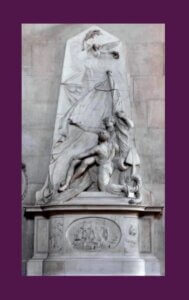
John Bacon the Younger, 1806
(© Dean and Chapter of Westminster)
Commissioned by the EIC, Cooke’s enormous (26’ x 12’) memorial by John Bacon the Younger (1777-1859) was installed in 1806. It backs on to one of the Abbey’s most famous 18thc monuments – Joseph Wilton’s 1772 tribute to Major-General James Wolfe (who had died, aged 32, on the Plains of Abraham, Quebec, in 1759).
Cooke is portrayed in a semi-recumbent pose, surrounded by naval items – a cannon beside an anchor and rope; a ship’s mast above his head – and supported by a man wearing classical drapery. An angel carrying a palm frond and laurel wreath hovers above him.
The sculpture clearly honours a young man who died after a battle, celebrating him as a military hero. Jennifer (an alert Canadian!) suggests that its extraordinary size and curious location is an attempt to associate Edward Cooke’s death with the ‘politically charged patriotism’ associated with Wolfe.
Unlike most of the artworks commissioned by the EIC, these four sculptures (and those at St Paul’s Cathedral and St George’s Church, Bloomsbury), are still in their initially intended locations. In her book Jennifer also examines the paintings and sculptures originally commissioned for East India House (and now dispersed across a variety of places), and traces the changing ‘messages’ emerging during the EIC’s gradual transition from a trading company to a bureaucratic agency of imperial rule.
*************
Information about the Abbey’s opening hours, times of services, range of tours and other events is available on their website here.
***************************************************************************
(Suggestions for BACSA website news items, volunteering opportunities and diary entries, are always welcome – please send them to ‘comms@bacsa.org.uk’.)