
Whether or not you are taking to the roads at this time of year, you may like to contemplate the challenges encountered by earlier travellers.
Ian Macpherson McCulloch (Lieutenant-Colonel (ret.), The Black Watch (RHR) of Canada, who is a BACSA life member from Kingston, Ontario, has sent us this article from the ‘Redcoat Images’ blog, managed and edited by Dr Greg Urwin of Temple University, Pennsylvania, USA. (Subscribers include ‘an international group of historians, curators, re-enactors, collectors etc who regularly discuss and view various 18th-century officers of the British and Indian armies’).
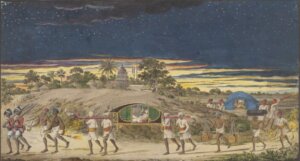
Feeling that BACSA readers would find this item of interest, Ian wonders ‘if any readers might even be able to identify the mystery chap and his wife following on?’
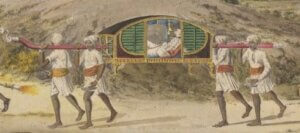
‘One of the most interesting things about the armies fielded in the 18th century by the three presidencies of the Honourable East India Company is the extent to which they blended both European and Asian practices. This scene by an unknown European or Indian artist offers a case in point. What we see here is a European infantry officer in uniform travelling down a dusty Indian road in a palanquin, or a covered sedan chair. This mode of travel is a litter that normally accommodated one passenger. A pole that ran through the palanquin enabled it to be carried by an even number of bearers. Four was the most common number, but it could be as many as eight or as few as two.
(YCBA B2023.2.3)
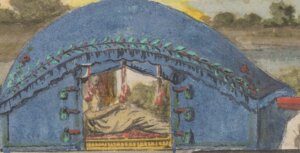
Palanquins came in different sizes and boasted varying degrees of comfort and style. A larger version, like the one seen here, was a rectangular wooden box eight feet long, four feet wide, and four feet high. It had openings on either side and was screened by curtains or shutters. The interiors contained bedding and pillows to make travel more comfortable. The higher the social status of the owner, the more ornately his or her palanquin was decorated. The one pictured here has green shutters, a lacquered body, and decorative gold edging. In addition, cast bronze finials are attached to the ends of the carrying pole.
(YCBA B2023.2.3)
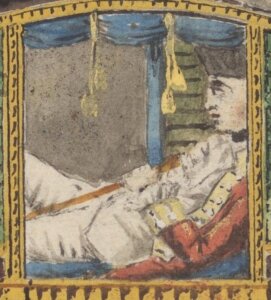
The Yale Center for British Art – at New Haven, Connecticut – has given this work (Accession No. B2023.2.3) a date of 1800, but the uniform on the British officer inside the palanquin in the centre foreground adheres to the fashions in vogue thirty years earlier.
He wears a scarlet regimental coat with yellow facings. The coat’s buttons are silver, as is the buttonhole lace. We can also see his white ruffled shirt, black stock, and white small clothes. A plain black cocked hat covers his head, and he appears to grip a walking stick, or perhaps it is a long-stemmed pipe.
A second palanquin following behind carries a woman, presumably the officer’s wife. In addition to the bearers carrying the palanquins, other Indian servants tote baggage and other items.
(YCBA B2023.2.3)
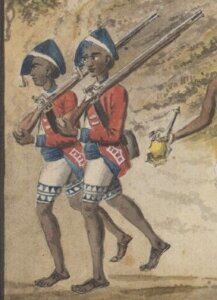
This little procession is preceded by a military escort — two sepoys with their firelocks sloped over their left shoulders.
These soldiers wear red coats with no lapels, but with dark blue collars, cuffs, and lining. Rectangular loops made of white lace decorate the front of these garments. White lace also adorns the vertical pocket flaps.
These soldiers’ white breeches or jangheas are handsomely decorated in blue at the bottom of each leg. Blue sashes circle the soldiers’ waists. A dark blue turban with a white stripe and tassel protects each man’s head. The sepoys are shod with sandals. Their accoutrements hang from black leather cross belts.
The officer pictured above could have been an important figure in 18th-century India. A pity that we do not know his name. Perhaps Eyre Coote, 3rd Carnatic War?’
(YCBA B2023.2.3)
Ian Macpherson McCulloch
****************************************************************************
Charles Greig, Art Historian and member of BACSA Executive Committee, comments: ‘An interesting piece – The artist of this image is unknown, but almost certainly English.’
Do you have any ideas as to who any of these 17 people – two travellers, two sepoys and 13 servants – might be? If so, please let us know.
(Suggestions for BACSA website news items, volunteering opportunities and diary entries, are always welcome – please send them to ‘comms@bacsa.org.uk’.)