
Mr Bharat P Maharugade, an Independent Researcher, and Co-Founder of the Heritage Society, Kolhapur, who believes that ‘those who dedicated their lives to the welfare and advancement of our city deserve to be remembered‘ has sent us this very interesting article about Dr George Arthur Sinclair (1828-1910):
‘On 2 November 2024, All Souls’ Day, I went looking for a grave.
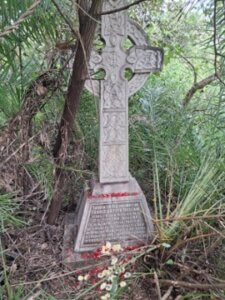
Christian cemetery, Kolhapur
Photo: Bharat Maharugade, 2 Nov 2024
For days I had searched Kolhapur’s old Christian cemetery behind the former Sangam Talkies, where the city’s British Residency community was buried. Creepers and tall growth had closed over parts of it, and the search was slow. With permission from the church authorities, I finally reached the furthest corner.
There, among the greenery, stood a six-foot Celtic cross of white marble, its shaft carved with interlace. The inscription began: ‘Sacred to the memory of George Arthur Sinclair, who entered into his rest 17th Sept. 1910, aged 82.’
A century earlier, his name was well known across Kolhapur. With the passing of generations, however, his name and work had gradually faded from public memory. We laid flowers on the plinth, and I resolved to tell his story.
A soldier’s beginnings
Two memorials tell us who he was before his Kolhapur saga:
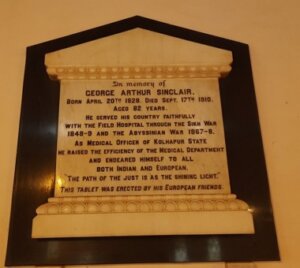
A marble tablet in All Saints Church records that he was born on 20 April 1828 and served his country faithfully ‘with the Field Hospital’ through the Sikh War of 1848–9 and the Abyssinian War of 1867–8.
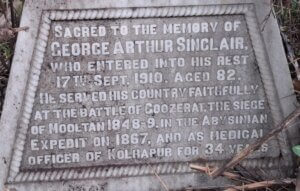
The cross over his grave adds the battle of Goozerat, the siege of Mooltan and thirty-four years as Medical Officer of Kolhapur. When his appointment to Kolhapur, in succession to the late Mr Anding, was announced in 1869, he was described as a ‘College trained man’, esteemed by many civil and military officers. A tribute of the time hailed the choice as proof that the prizes of the service went to ‘genuine merit and no favour’.
A pioneer of modern medicine in Kolhapur
The city he found on his arrival was wary of Western medicine. A small European-style dispensary had existed since 1851, but its work centred largely on vaccination and epidemic control. As his patients multiplied, the existing arrangements became inadequate, and the Albert Edward Hospital came into being in 1884, with Sinclair playing a leading role in its medical work. Kolhapurkars called it thorla davakhana (थोरला दवाखाना), the ‘Elder Hospital’. Today it is known as ‘CPR Hospital’.
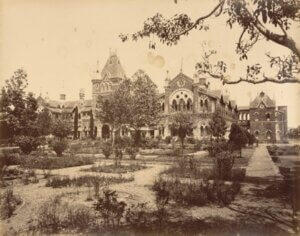
From the Lee-Warner Collection
Training women
Sinclair’s most far-sighted work concerned women. In October 1885 a meeting in Kolhapur, under his direction, resolved to ask the medical faculty in Philadelphia for a lady doctor to teach medicine to the women of the Southern Maratha Country. Sinclair proposed something humbler: a qualified European nurse-midwife to train a class of local women. An English nurse, Mrs Sarah Sykes, was engaged, and in June 1888 eight pupils began an eighteen-month course. Half could not read or write. Sinclair and his adviser at Bombay’s Grant Medical College agreed that this need not matter, since a simple, practical training was all that was wanted.
On the evening of 30 January 1890, the hospital’s staircase and hall were decked with flowers for the prize-giving of the first batch of nursing. Sinclair spoke for a cause that, in his words, ‘must come near to every woman’s heart’. The Dewan read a paper on this training programme, which he credited to Sinclair’s foresight. Distinguished Indian people urged the Bombay Government to train native midwives in its hospitals as Kolhapur already had. All who saw it agreed that Sinclair, whom all Kolhapur ‘know and love’, had reason to be proud of a scheme that in a land of caste had promised little.
The work continued. When Dr Krishnabai Kelavkar opened another class in 1905, ten of twelve pupils qualified: Brahmin widows, a Muslim, a Rajput, a Koli, Marathas and a Jain, probably the first of their caste in the Bombay Presidency to take up nursing. Dr Kelavkar gave the credit to Sinclair, by then retired.
A citizen of the town
Sinclair was no distant Residency official. In his years as Medical Officer he saw the city’s walls pulled down and its Town Hall, New Palace, bridges, railway and Kalamba water supply raised. He served through the reigns of three rulers, attended the coronation of Shahu Maharaj, and issued the medical bulletins when Shivaji IV fell ill. In 1871, when the Political Agent, Colonel Anderson, fell seventeen feet (after stepping out of a bedroom onto a Residency verandah that was being rebuilt), it was Sinclair who attended him. In 1897, at the foundation-stone ceremony of the new Infantry Service Hospital, a speaker declared that there was ‘never a day or a night too long’ for the doctor if anyone needed him. His name also appears among Kolhapur’s contributors to a famine relief fund, beside the Political Agent, the Rajah and the S.P.G. Mission.
Sunnyside
He chose to live close to the town, not at the Residency. His bungalow, Sunnyside, stood on two acres beside the Jiti Nullah on the old Kolhapur Trunk Road, now Bhausinghji Road, and Residency Britons called it the ‘Palace of Sinclair’. Its garden flowered all year and was a sanctuary for birds. His son Reginald, who was born there in 1874, grew up to play first-class cricket in India and to join the Indian Civil Service. In January 1888 one of Sinclair’s daughters married the Rev. Adam Clark Laughlin of the S.P.G. Mission, and another, Blanche Emily, married Captain John Henry Clabby at St Thomas’ Cathedral, Bombay.
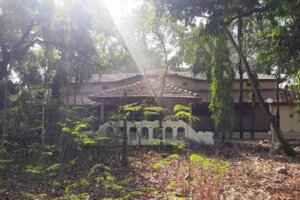
Photo: Bharat Maharugade
Sorrow followed. A daughter, the wife of State Engineer R. J. Shannon, died at Sunnyside, and in 1900 his wife died of a liver ailment. Her coffin left for the Residency cemetery.
At the age of 75, glaucoma forced him to retire in 1903 after a service of 34 years in Kolhapur, but European visitors to Kolhapur made a point of calling on the ‘oldest European inhabitant of Kolhapur’. Even in old age he was seen striding down the Kolhapur Trunk Road towards the Residency, four miles every evening, rain or shine. There are memories of Kolhapur people from those days about Sinclair quietly sitting in his porch looking west towards the river Panchganga. He died in 1910, and lies in the cemetery where this story began.
What remains
Kolhapur’s European community honoured him in marble as well. The tablet in All Saints Church, erected by his European friends, says that as Medical Officer of Kolhapur State he raised the efficiency of the Medical Department and endeared himself to Indians and Europeans alike. It ends with a line from Proverbs: ‘The path of the just is as the shining light’.
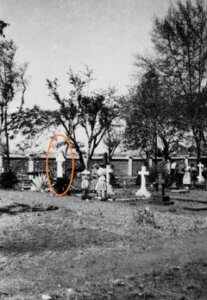
in the 1940s, when a camp for
Polish refugees stood nearby.
Dr Sinclair’s cross is circled at left
Source: Poles in India 1942-1948
(Association of Poles in India 1942-1948)
Sunnyside still stands, and for many years was the official residence of the CPR Hospital’s civil surgeon. When its Gothic stone gate pillars were recently taken down, local citizens like Firoz Shaikh spoke up, and they are now being rebuilt.
A photograph from the 1940s, taken when a camp for Polish refugees stood near Kolhapur, shows visitors among the graves, with Sinclair’s tall cross rising at the left and a boundary wall behind.
Eighty years on, the cross still stands, its marble intact, and the tablet still hangs in the church he knew. Kolhapur has largely forgotten the doctor’s name, though he watched the town change from an old walled city to the age of the motor car (1869-1910), and the hospital that grew from his dispensary still serves it. For readers of this newsletter, who know better than most what it means to find such a gravestone, I hope this account restores a little of his story’.
Bharat P Marharugade
Independent Researcher – History of Kolhapur
Co-founder, Heritage Society, Kolhapur
Ed Note:
As readers of Chowkidar will know, Mr Bharat Maharugade would like to hear from any of Dr George Arthur Sinclair’s descendants, and from any researchers or institutions who are interested in Dr Sinclair’s life and service. He is keen to find out whether any of Dr Sinclair’s personal papers, photographs, medals or family records have survived. Please email comms@bacsa.org.uk if you can help with this enquiry.
********************************************************************************* (Suggestions for BACSA website news items are always welcome – please send them to ‘comms@bacsa.org.uk’.)