
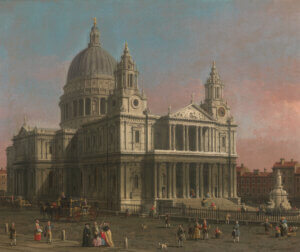
(Canaletto, c.1754)
Our tour was arranged by BACSA Chairman Paul Dean, and led by Dr Jennifer Howes, an art historian whose book ‘The Art of a Corporation – The East India Company as Patron and Collector, 1600-1860’ (Routledge, 2023) has recently become available in both paperback and Kindle editions.
Designed by Sir Christopher Wren to replace the building destroyed in the Great Fire of 1666, St Paul’s Cathedral was completed in 1710. The cathedral floor was intended to be an open area, with monuments located in the crypt. This changed in the 1790s, when Parliament demanded that St Paul’s be used to commemorate Britain’s heroes of empire. The Dean and Chapter of St Paul’s stipulated that the ‘first four’ floor memorials should be to ‘men of knowledge’, and placed at the NW, NE, SE and SW crossing points below the dome.
1799: William ‘Orientalist’ Jones (1746-1794)
A prominent Orientalist scholar, William Jones, a Judge on the Bengal Supreme Court at Calcutta, studied Sanskrit at Varanasi and established the Asiatic Society, sponsoring the first translation of the Bhagavad Gita and triggering ‘an outpouring of scholarship on the civilisation of what Jones called ‘this wonderful country’ (Dalrymple, 2019).
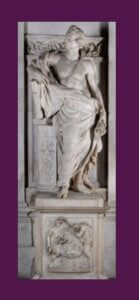
1746-1794
(John Bacon the Elder, 1799)
Jones died in 1794, and was buried at South Park Street Cemetery, Calcutta.
Commissioned by the EIC, a memorial honouring him was executed in white marble by John Bacon the Elder (1740-1799), and installed under the SW corner of the dome of St Paul’s in 1799.
Wearing a toga, Jones holds a quill in one hand; a scroll labelled ‘Plan of the Asiatic Society’, in the other. He leans on a copy of his book ‘The Institutes of Hindu Law’, which rests on a podium decorated with the scales and sword of Justice, and a lyre – symbols of his legal career, and early poetic writing. The plinth below shows three images reflecting his later interest in Indian languages and culture – a young woman dressed in a sari – personifying the Ganges; flanked by Brahma and the Kurma Avatar of Vishnu.
In contrast to the military memorials it had commissioned for Westminster Abbey, the EIC here presented its support for the peaceful, civilising activities of the late 18thc ‘Oriental Renaissance’. The inscription mentions the Company’s gratitude for Jones’s public services; admiration for his ‘genius and learning’, and respect for his ‘character and virtues’.
Positioning Jones’s memorial in such a prominent location, grouped with Baker’s memorials for John Howard, prison reformer and philanthropist, and Samuel Johnson, poet, scholar and lexicographer (which were already in situ in the SE and NE points under the dome), ‘suggests an appreciation of scholarly assiduity and a humanitarian, tolerant, facet of British rule in India’.
1826: Major-General Robert Rollo Gillespie (1766-1814)
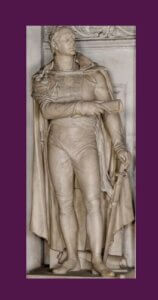
Gillespie, 1766-1814
(Francis Leggatt Chantrey, 1826)
Noted for his exploits in the West Indies, Java and India, Gillespie, aged 48, was killed in 1814 during the Battle of Kalunga, following which he was buried at Meerut.
Parliament moved quickly to arrange a national monument to the hero of Kalunga. A memorial to Gillespie was proposed by Lord Castlereagh, the Tory Foreign Secretary, in the House of Commons on 21st June 1815. Executed by Francis Leggatt Chantrey (1781-1841), it was installed in the South Transept, Centre Aisle of St Paul’s in 1826.
Eschewing classical allegory, Chantrey depicted Gillespie in a Major-General’s uniform, with a highly decorated, embroidered jacket and a medal pinned to his chest. A heavy cloak, held on his shoulders with tassels and a thick cord, falls to his feet. A fringed sash sits around his waist. In one hand he holds a scroll, which, like the scroll at his feet, presumably represents military orders and plans.
1835: Bishop Reginald Heber (1784-1826)
After being consecrated as Bishop of Calcutta, Reginald Heber arrived in India in October 1823.
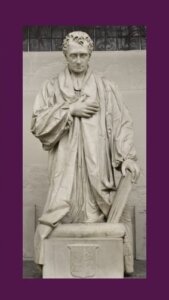
(Francis Leggatt Chantrey, 1835)
Alan Tritton, erstwhile BACSA President, quotes Heber’s impressions of Calcutta’s Botanical Gardens: ‘It is not only a curious but picturesque and most beautiful scene and more perfectly answers Milton’s idea of Paradise than anything I ever saw’.
Heber triggered two centuries of historian headache during his 1824 visit to Dacca, where (per the BACSA post of 25/3/25), he consecrated the Narinda burial ground, and noted in his diary that ‘the old Durwan’ called the large monument the tomb of ‘Colombo Sahib’.
Following her chance discovery of Archdeacon Firminger’s 1917 epitaph transcriptions in Bengal Past and Present, BACSA historian Rosie Llewellyn-Jones concluded that Heber’s note was based on an aural distortion of ‘[Nicholas] Clerembault, Esq.’ the London-based Huguenot family member who had become ‘Chief of Ye English Factory at Dacca’, and died in 1775.
Heber died, aged 42, in 1826, and was buried at St John’s Church in Trichinopoly. A collection of his hymns, including ‘From Greenland’s icy mountains, from India’s coral strand…’ and ‘Holy, Holy, Holy! Lord God Almighty’, was published shortly afterwards.
Heber’s memorial was, like Gillespie’s, executed by Francis Leggatt Chantrey. Completed in 1835, it was installed in the Crypt of St Paul’s (Chapel of St Faith, South Aisle).
A note on the sculptor:
Francis Leggatt Chantrey (1781-1841): Famously self-taught – he had ‘never had an hour’s instruction from any sculptor in my life’ – Chantrey displayed ‘a great gift for characterisation’; his ‘ability to render the softness of flesh’ was much admired. (Per the BACSA post of 11/5/25), his 1820 sculpture of Dr James Anderson at St George’s Cathedral, Madras, was called a ‘wonderfully lifelike and natural’ work).
Ironically, as BACSA member Stephen McClarence points out, ‘Despite all the wonderful memorials he sculpted, Chantrey’s own [at Norton, near Sheffield] is a plain unornamented slab’.
1862: Henry Montgomery Lawrence (1806-1857)
The Chief Commissioner of Oudh, Henry Lawrence died on 4 July 1857 from wounds received during the attack on the Residency at Lucknow. He was buried in the Residency grounds.
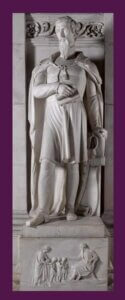
1806-1857
(John Graham Lough, 1862)
A memorial to Lawrence, funded by the SPCK (Society for Promoting Christian Knowledge) and the SPG (Society for the Propagation of the Gospel), was executed by John Graham Lough (1798-1876), and installed on the west wall of the East Aisle of the North Transept of St Paul’s in 1862.
The statue, in white marble, shows Lawrence with one hand holding an unfurling scroll; the other a leather-bound volume, resting on a second book. Beside him is a sword with a curved Indian, talwar–style Sikh blade – possibly modelled on the sword presented to him in 1842 by the Maharajah of Lahore.
In a reference to Lawrence’s ‘Military Asylum’ at Sanawar – a hill station boarding school for protecting the children of British soldiers from ‘the debilitating effects of the tropical climate, and the demoralizing influence of Barrack-life’ – a relief below the plinth portrays him seated on a low chair, welcoming a group of three children with a matronly woman.
By omitting Lawrence’s medals (eg his KCB) from the sculpture, and any mention of his military rank (Brigadier-General) from the inscription, Lough’s memorial focuses attention on Lawrence as a philanthropic ‘man of action’, in keeping with his chosen epitaph ‘Here lies Henry Lawrence who tried to do his duty’.
*****
For details on the many other memorials with Indian connections at St Paul’s, please click on the EIC digital trail, created with Stepney Community Trust, and pantheons-st-pauls.york.ac.uk, an academic research project hosted at the University of York’s Department of the History of Art.
Information about the Cathedral’s opening hours, times of services, range of tours and other events is available on their website here.
***************************************************************************
(Suggestions for BACSA website news items, volunteering opportunities and diary entries, are always welcome – please send them to ‘comms@bacsa.org.uk’.)