
St Mary’s Cemetery on the Island, Chennai
Phase 3 of this BACSA project has been successfully completed!
St Mary’s cemetery was established in 1763, when the ‘guava garden’ cemetery, much closer to the church, was cleared to improve the fort’s defence against French incursion.
BACSA members will recall that Phase 1 of this project (completed in 2021) consisted of repairs to the boundary walls and the roofs of the entrance, as well as conservation of 14 graves on the north side of the central area of the site. Click here to read a report on Phase 2 (completed in 2024), which covered conservation of the monument to James Anderson (1809), a founder of the Madras Botanical Garden, plus the consolidation and paving of the central avenue with laterite stones.
Denise Love, BACSA Projects Coordinator, reports on the latest BACSA-supported conservation work carried out at St Mary’s Cemetery on the Island, Chennai.
Denise writes: ‘BACSA’s major project at this cemetery, one of the oldest in South Asia, is continuing to make good progress. Phase 3 has finished this Summer. It involved the conservation of five graves of architectural interest, the rescue of another major pathway in the cemetery and a thorough clearance of the fifteen graves and the central avenue which had been restored in the first two phases’.
The five tombs selected by our contractors, Jeernodhar (and endorsed by our Area Representative, Ravindra Gundu Rao) for conservation in Phase 3 were all impressive monuments with names and inscriptions. They date from 1796 to 1809, and are located south of the central avenue. Those for Major Thomas Gordon (1798), Charles Smart (1798) and Thomas Rumbold Taylor (1804) are listed in Cotton’s 1905 (revised 1945) ‘List of Inscriptions on Tombs or Monuments in Madras, possessing historical or archaeological interest’. Thomas Taylor’s tomb is a low, rectangular structure, whereas the other two, like those of Harriet Dent (1796) and Elizabeth Webb Chambers (1809), have square bases and obelisks.
In each case the conservation work involved:
•Cleaning the monument, and removing vegetation
•Removing damaged plaster and applying a fresh coat of rough plaster to the surface
•Applying a final coat of plastering (after appropriate curing of the primary lime plaster coat).
•Iterating the ornamentation (eg column fluting) and corners to bring back the original design and features.
•Cleaning the name plate; making it legible and easy to read.
•Where necessary, inserting a damp proof course to arrest capillary rise of dampness into the masonry of the monument.
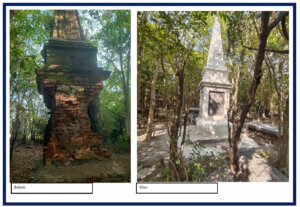
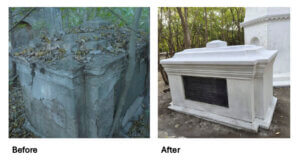
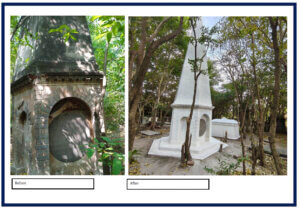
The ‘Before’ and ‘After’ photos below are included in the Project Report prepared by Jeernodhar Conservators Pvt. Ltd in association with RGR.
Harriet Dent (1766 – 1796)
Harriet Dent died on 18 September 1796, aged 30.
Major Thomas Gordon (c.1753-1798)
Thomas Gordon entered the Madras Army as a Cadet in 1775. He became 2nd Lieutenant on 19 January 1776; Lieutenant on 8 November 1780; Captain on 20 December 1789 and Major on 1 June 1796.
Thomas died on 17 September 1798, aged 45 years.
Charles Smart (c.1755-1798)
Charles Smart entered the Madras Army as a Cadet in 1771. He became 2nd Lieutenant on 14 November 1772; Lieutenant on 14 November 1778; Captain on 23 December 1783 and Major on 1 June 1796. He married Sarah Anna Barlow at Fort St George, Madras, on 4 September 1792.
Charles died on 3 October 1798, aged 43 years. Jeernodar note that ‘his tall monument, with an obelisk on the top, is recorded as being ‘the largest monument in the cemetery’. What makes it unique is the design and the use of soft arches in its construction’.
Thomas Rumbold Taylor (c.1776-1804)
Thomas Rumbold Taylor, the Captain of the Honourable Company’s ship Glory, was killed by Major William Davidson in a duel. (Cotton refers interested readers to ‘Public Department Proceedings Sundries, for 1804’).
Thomas died on 4 March 1804, aged 28. (William Davidson was dismissed, in England, on 26 March 1806).
Elizabeth Webb Chambers (d. 1809)
Elizabeth Webb Chambers died in 1809.

What next? Denise continues: ‘The Executive Committee has now decided that a large central area needs to be cleared of undergrowth and then mapped to show all the existing monuments and tombs. In future we hope that local communities and organisations will collaborate with us on developing a landscape plan for what used to be a lovely garden cemetery. And that we can commission from interested researchers a work on St Mary’s history and notable interments, which we would like to display on information boards at the Gothic style entrance’.
Denise Love and Rachel Magowan
****************************************************************
(Suggestions for BACSA website news items are always welcome – please send them to ‘comms@bacsa.org.uk’.)