This is an abridged version of an insightful, well researched article on Lady Jane Munro (1795-1850) by Stephen Martin, a psychiatrist who researches art history and supports a museum in rural Thailand:
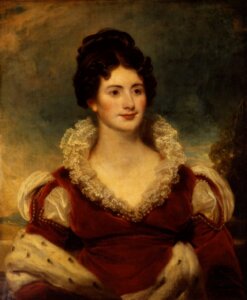
(National Portrait Gallery. London, NPG 3124a)
‘This 1819 portrait of Jane Munro by Sir Martin Archer Shee, in London’s National Portrait Gallery, is ‘a study in serene elegance’. However, the poise captured belies a life defined by harrowing extremes and near miraculous resilience. Following her husband, Sir Thomas Munro, to Madras, Jane’s Indian odyssey was marked less by colonial splendour than by a series of profound personal issues: a traumatic brain injury that nearly cost her her faculties, the agonising near-death of her youngest son, and eventually, forced separation from the man she loved. While Jane returned to Scotland to rebuild a fractured life, Sir Thomas remained in India, ultimately falling victim to the very cholera epidemic he had dedicated his final days to eradicating.
Jane’s story is more than a footnote to a Great Man’s career; it is a poignant narrative of survival, maternal devotion, and the devastating human cost of life in Regency India.
Aged 19, Jane Campbell, who had been born in Ayrshire in 1795, married Colonel Thomas Munro, a fellow Scot aged 54. They sailed to India in 1814. Jane, whom Munro’s biographer, George Gleig, described as ‘beautiful and accomplished’, and ‘a lady remarkable for the correctness of her manners and steadiness of her principles’, seemed to be the person without whom Munro’s ‘own happiness…could not operate.’
On becoming married, Thomas Munro, a lifelong army officer, mused on the shift to domesticity after having spent most of his adult life ‘in a tent’. Five years later, about to leave Britain (‘home’) once again for India, he wrote in December 1819 ‘… as I must return to India, I am impatient to be there. My attachment to both countries is so nearly equal, that very little turns the scale. I like the Indian climate and country much better than our own; and had we all our friends there, I would hardly think of coming home; but this country is the country of all our relations and of early life, and of all the associations connected with it.’
Munro achieved fame and distinction as Major-General, Baronet, Governor of Madras Presidency, and for being ‘a very good man’. Their story tells the rich pattern of life in Regency India; their monuments in Chennai and Ayr signify the wrench of separation.
Jane had two sons. The first, Thomas, was born at St Helena in 1819, while Jane was sailing to Scotland. To avoid exposing her baby to tropical diseases, Jane arranged for him to be cared for by her family in Scotland, while she returned to India.
During this visit home Jane sat for her portrait with Sir Martin Archer Shee. Her baronial-style white and red split-sleeve velvet dress with ermine tails and (likely) Coromandel pearls (probably from Thiruchendur or Thoothukudi, both on the Coromandel Coast near Chennai) clearly identify with both Thomas Munro and India.
In 1821 Jane sustained a serious injury in Southern India, when she fell headfirst from a horse ‘the concussion was so great that she was for some days insensible, and one of her eyes has not yet recovered its proper place’.
The description is completely convincing for a severe traumatic brain injury with several days of documented, reduced consciousness; her squint may have been due to brain, nerve or eye muscle damage, any of which can recover progressively.
Very ill with ‘eye injury’, Jane was effectively separated from her family in India for a whole year. After eight months her eye defect had become ‘so slight as to be of no great consequence’ and she was able to travel under medical advice. Eventually ‘her recovery, though tedious and distressing, was complete.’
Jane’s second son, Campbell, was born in India in 1824. Two years later Campbell became gravely ill with a fever – precisely the reason why his elder brother Thomas had been left in Scotland. Concerned that he might not survive, Jane took Campbell to Scotland in March 1826. (In the event, Campbell Munro did survive; he lived to be 90, and his son, the mountaineer Hugh Munro, became famous for listing the ‘Munros’ – Scottish peaks over 3,000’.)
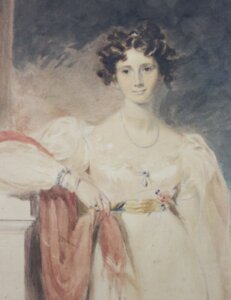
(Oil painting was recorded at Government House Madras, in 1903; this picture, believed to be Lawrence’s planning watercolour, was sold at auction in 2016)
That year Sir Thomas Lawrence painted Jane Munro in a white dress with a sapphire and pearl brooch and Indian silk waist sash. This second major oil portrait of Jane hung in Government House, Madras, and Lawrence’s watercolour planning picture for this portrait appears still to exist. In this portrait, Jane has a hint of an outward squint in her right eye from her accident, because her pupil reflections are not equally placed. (In Shee’s earlier painting, the pupil reflections are identical. Both of Jane’s portrait artists, Shee and Lawrence, became Presidents of the Royal Academy).
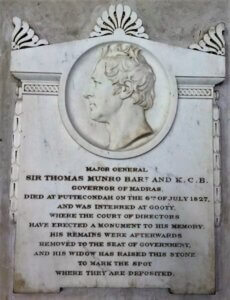
to Sir Thomas Munro, by Chantrey,
St Mary’s Church, Chennai
Also in March 1826, Thomas Munro wrote up a report on Education. Almost certainly with Jane’s collaboration, he calculated how many more Hindu and Muslim schools were needed, even though he felt that the teachers’ overall pay and conditions were better than in Scotland. The work highlighted religious differences in pupils and that Indian girls were attending school at only 1% the number of boys, despite the fact that by then every village had a school. It is also reasonable to infer that it was with Jane’s support that Thomas Munro reformed the judicial system, enhancing the power of village-based, mofussil local magistrates.
Jane’s involvement is implied with the completion of the Education report on her departure, especially given his comment in a later letter to her: ‘I do not see what use either you or I can be of any longer in this country.’ Though scant, this firmly links Jane to his work.
Thomas Munro died from cholera, in Puttecondah (now ‘Pattikonda’), on 6 July 1827, while attempting to prevent cholera spreading in rural Andhra Pradesh by ensuring the provision of clean water supplies. He was initially buried in Gooty European cemetery, 20 miles to the south (where a kerbed, inscribed black stone slab indicates the original tomb); his mortal remains were later interred in St Mary’s Church, Madras.
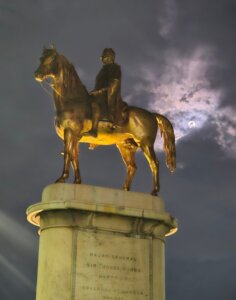
of Sir Thomas Munro by Chantrey,
near Island Grounds, Chennai
Widowed at the age of 32, Jane commissioned Francis Legatt Chantrey, working in London, to carve a white marble portrait medallion memorial plaque and ship it out to India. Located near the chancel on the penultimate north aisle pillar in the nave, it has a low pediment, honeysuckle anthemeon finials, and carved threaded flower garlands hanging at either side.
In 1839 a bronze equestrian statue of Thomas Munro, locally known as ‘The Stirrupless Majesty’ was installed near the Island Grounds, Chennai. Also sculpted by Chantrey, it shows Munro riding without a saddle or stirrups, symbolising selfless effort.
(It is a great credit to Chennai that it recently finished a glorious restoration of this statue, including the surrounding flowerbeds).
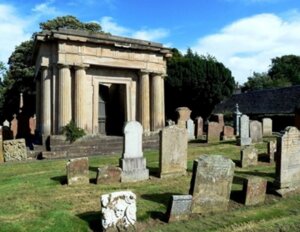
Aged 55, Jane died at Ayr, on 2 September, 1850. Her memorial is William Henry Playfair’s handsome Greek family mausoleum in sandstone at Auchincruive Church, St Quivox village, Ayrshire.
Jane was without doubt a positive figure in the history of India. More should be known about her, but extensive writing of only a handful of English women in Regency India has survived. Rare examples are Journal of a Residence in India by Maria Graham (1813), and The Manners and Customs of Society in India by Eliza (‘Mrs Major’) Clemons (1841), which contain much intelligent psychological-mindedness and anthropology. They can be read free, open-access online (click the links) and are very absorbing, with deeply sincere interest in Indian women. There are no surviving written accounts from native Indian women in the Regency; a sad reflection of the very low school attendance identified by the Munros at 1%, and the contingently hampered literacy, all of which the Munros clearly fought to progress.
Though their monuments are on separate continents, the strength of the Munros’ efforts shines in unity across two centuries. Good people in Regency India tried mightily hard to do good work’.
Stephen Martin
Ed. Notes:
•Click here to read Stephen Martin’s full article (including psychological insights and source references), published in Hektoen International Journal of Medical Humanities, July 2025.
•Spoiler alert! We are delighted to hear that Stephen’s full article is to be published in booklet form to support a lecture at the Auchincruive church, St Quivox, Ayrshire, where Jane Munro was interred.
Rachel Magowan
***************************************************************************
(Suggestions for BACSA website news items, volunteering opportunities and diary entries, are always welcome – please send them to ‘comms@bacsa.org.uk’.)