
An enthusiastic admirer of the writings of George Orwell (the pen name of Eric Arthur Blair), BACSA member Darcy Moore, a deputy principal at a school in New South Wales, Australia, tells us about his recent travels in India researching Orwell’s family background, his birth and early days in Motihari, Bihar:
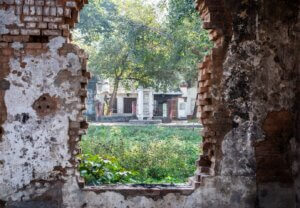
Photo: Darcy Moore
‘Eric Arthur Blair, better known as George Orwell, the author of Nineteen Eighty-Four and Animal Farm, always described himself as coming from an Anglo-Indian family. Reading the recent BACSA post about Mussoorie’s Camel’s Back Cemetery led me to reflect on some sad tales from my own research trip to India on the trail of the author’s heritage.
Orwell’s parents, Richard W. Blair and Ida M. Limouzin, were married on the 15th June 1897 in Nainital, a popular hill station with the rare attraction of a natural lake, 345 km northeast of New Delhi. It was an exciting time in Naini as Diamond Jubilee celebrations for the 78-year-old Queen Victoria, Empress of India, were in full swing. This included an event, on the eve of their wedding at St John’s in the Wilderness Church, where a balloon ascended above the lake to 7000 feet before the heavy weather forced the balloonist to parachute spectacularly to safety, as the assembled crowds watched on.
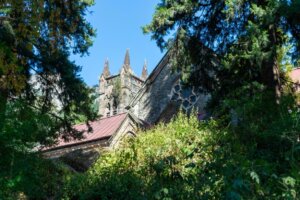
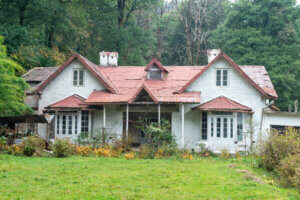
The only relative who attended their wedding was Blanche Limouzin, Ida’s sister, who was working as a teacher in nearby Mussoorie. It is probable that Ida was also working as a teacher in Naini, where she rented Fern Cottage from Mr Elliott, a long-serving and well-respected local principal.
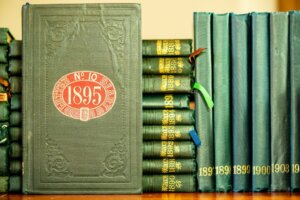
Richard Blair had spent his entire adult life, since the age of eighteen, working in the Opium Department of the Indian Civil Service. The nature of his work, as a Sub-Deputy Opium Agent – ensuring the quality of the supply, collection and distribution of the drug that helped keep the British Empire solvent – became clearer after I read the diaries of a contemporary employed in the same work.
On the 25th June 1903, their only son, Eric Arthur Blair, was born in sight of the Himalayan Mountains, at Motihari, where his father was stationed. Their three-room bungalow was conveniently located near a large warehouse (godown) used for storing opium before it was processed and exported to China. Ida must have been greatly saddened that her sister died of pneumonia just two months before Eric was born. Aged 28, Blanche was buried at Camel’s Back Road Cemetery in Mussoorie, on the 13th April 1903.
During the year he spent in India, like most Anglo-Indian children, Orwell had an ayah. While visiting Motihari, I endeavoured to uncover this unknown woman’s identity without success. The photographer, Harry Bailey, had been employed by Johnston & Hoffmann in Calcutta before establishing his own business in Muzaffarpur. He died horribly from an ‘inflammation of the stomach’ a little over a year after taking a photo of baby Orwell.
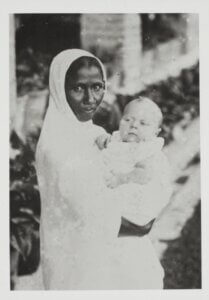
Photo: Harry Bailey, Muzaffarpur
Harry was buried by the same chaplain, Reginald Yates, who baptised Orwell. I visited the cemetery in Muzaffarpur but could not locate his final resting place.
Orwell really hated and feared rats. His novels, correspondence, diaries and essays detail this obsession. Anyone who has read Nineteen Eighty-Four knows the infamous episode where the protagonist, Winston Smith, is tortured by rats. Oral history indicates that Eric Blair was bitten in his cot by one as a baby in Motihari.
Young Orwell spent less than a year in India before escaping the plague sweeping Bihar with his mother and sister to England. Other British families in Motihari were not so fortunate.
On 28th March 1904, Richard Blair was transferred to a new station. The following month, Reverend George Hicks wrote ‘death and the grave are never far from the living in India’ after his first-born son, George Gibson Hicks, just three months old, died of dysentery brought on by malaria. Just a few days before his son died in Motihari, Hicks, who was a member of a newly formed interdenominational Protestant evangelical group, the Regions Beyond Missionary Union, had been appointed as registrar for births, deaths and marriages.
Orwell and his ancestral connections to India are extensive and largely unknown. My research is ongoing as one of the keys to understanding Orwell’s outlook and writing is to understand his identity as an Anglo-Indian.
Orwell constantly read and reviewed books about India and Burma. One book I would encourage you to track down and read is India Called Them reviewed by Orwell in 1948.
If you are interested in exploring Orwell’s connections to the sub-continent in more depth, here is a talk given to The Orwell Society which includes video of his birthplace.’
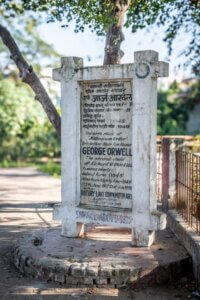
Darcy Moore
NOTE ON THE CONTRIBUTOR
‘Darcy Moore received the Peter Davison Award from The Orwell Society for his distinguished research into the life and writings of George Orwell. He has chapters in the forthcoming Routledge Companion to George Orwell and Orwell in Context (Cambridge University Press). Darcy blogs at darcymoore.net and his X/Twitter handle is @Darcy1968. His Orwell Studies Library can be accessed at darcymoore.net/orwell-collection/. Darcy welcomes correspondence: dfjmoore@gmail.com’.
***************************************************************************
(Suggestions for BACSA website news items, volunteering opportunities and diary entries, are always welcome – please send them to ‘comms@bacsa.org.uk’.)