
This free exhibition, which opened recently at the National Army Museum (Royal Hospital Road, Chelsea, London SW3 4HT), includes over 50 original drawings made during World War I by the French artist Paul Sarrut, who served as a liaison officer and interpreter with British, French and Indian troops on the Western Front.
As the NAM website tells us: ‘Living among the men he drew, Sarrut captured their daily life at close quarters – in camps, billets and medical stations. He signed and dated most of his sketches, frequently also noting the regiment and location.
Paul Sarrut (1882-1969)
After completing his French national service in the 40th Regiment of Infantry in 1906, Paul Sarrut (1882-1969) studied at the École des Beaux-Arts in Paris. By 1909 he was an accomplished professional artist and engraver, exhibiting at the Salon des Artistes Français.
Two days after the general mobilisation of the French Army in August 1914, Sarrut re-joined from the reserves. Aged 32, Corporal Sarrut was immediately seconded to the British Army as a translator for the Indian and British troops in France.
Posted to Marseille, Sarrut became intrigued by the distinctive uniforms, languages and traditions of the men of the Indian Corps, who started arriving at the end of September. He began drawing simple line sketches of the men on their arrival, their life in camp and their progress north across France to the Western Front.
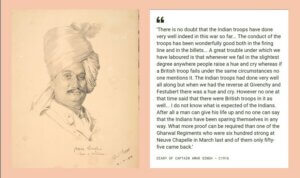
Captain Amar Singh
By 10 October Sarrut and the 3rd (Lahore) Division had reached Cercottes, just north of Orléans. Here Sarrut began drawing more detailed studies of officers and other ranks of the Indian Army, frequently annotated with their names. One in particular, dated 16 October 1914, depicts Captain Amar Singh, who served as an aide-de-camp with the 9th (Sirhind) Brigade, and kept a diary describing his unit’s part in the fighting on the Western Front.
Mohan Ram
Sarrut spent much of the winter of 1914-15 in the town of Locon, 8km north of Béthune, in Pas-de-Calais. Mohan Ram, drawn on 2 November 1914, was one of the dholi (stretcher) bearers whose work was seriously impacted by the very cold weather.
Sepoy Harnam Singh
One of the best-known images of a WW1 Indian soldier is that of Sepoy Harnam Singh, of the 34th Sikh Pioneers, whose portrait Sarrut sketched on 7 November 1914. Tragically Harnam Singh was killed in action later that month. Sarrut noted that Harnam Singh was a ‘Tarkhan’ [ ਤਰਖਾਣ ], a carpenter by trade.
(The Commonwealth War Graves Commission website also tells us that he was the son of Mahtab Singh, of Todar Majra, Kharar, Ambala, Punjab; his Service No. was 1756, and he is commemorated on Panels 29 and 30 of the Indian Memorial at Neuve Chapelle, in Pas-de-Calais).

Sarrut continued sketching the men of the Indian Corps until they were redeployed to Mesopotamia at the end of 1915. Continuing to serve as an interpreter, he sketched British officers and NCOs at Amiens until he was demobbed in 1919.
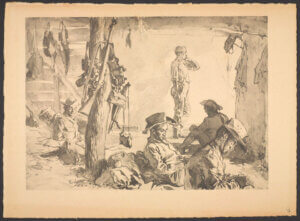
‘In this scene, Gurkha soldiers are sleeping, reading and writing while one stands watching the doorway. Their weapons and equipment lie around them and suspended from the beams’.
The NAM exhibition also includes uniforms, photographs, medals and archival material providing additional insight into the people, places and events captured in Sarrut’s drawings. Medals on display include the Victoria Crosses awarded to Lieutenant Frank de Pass, the first Jewish recipient, and to Sepoy Khudadad Khan, who was both the first Muslim, and the first soldier from the Indian subcontinent, to receive the award. Extracts from the diary of Jemadar Kirpal Singh of the 34th Sikh Pioneers, read in Punjabi by his grandson Dr Gurpreet Singh, form part of the interactive displays’.
Click here for more information about the National Army Museum and this exhibition, which runs until 21 February 2027.
****************************************************************************************
(Suggestions for BACSA website news items, volunteering opportunities and diary entries, are always welcome – please send them to ‘comms@bacsa.org.uk’.)
Rachel Magowan