
Darjeeling Past and Present: Part 2 (of 2)
(This is the second part of BACSA member Celia Brown’s article on the history of Darjeeling. Click here to read Part 1, which covered the early history of the town).
Many of Darjeeling’s founders and their families are buried in Hill Cart Cemetery, the first cemetery in the town, which was consecrated in 1824. Celia found it ‘in a bad way’ earlier this year, and hopes that BACSA will soon be invited by the local church authorities to renovate the site.
Tea plantations
By 1868 the tea industry was well established. Pioneers such as Andreas Wernicke planted some of the most successful gardens. The Wernicke family belonged to a group of Moravian missionaries who were among the first European settlers. The leader of the group was Karl Neibel, who translated the Bible into Lepcha. The missionaries preached the gospel in pidgin Lepcha in the bazaars and rapidly ran out of funds.

extremely cold winter (Photo: Das Studio Collection)
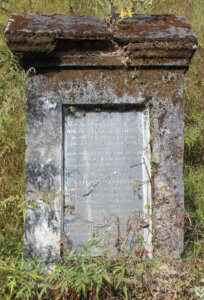
(1815-1861), Hill Cart Road Cemetery,
Darjeeling (Photo: Lyon J Lyell)
Coming from agricultural backgrounds, they began running a farm, and were soon supplying the town with dairy food, beef and pork. Planting tea was also a natural step for Andreas to take, and soon he and his sons and daughters were in the business of planting tea. Other settlers were also encouraged to plant tea seeds and were initially helped by the government to establish many of the tea gardens which are still producing the famous Darjeeling brew.
Planter’s Club
By now there was a growing need for a place for planters to gather and socialise and in 1868 the present Planter’s Club, a residential and dining club, opened its doors to its first members. The Maharaja of Cooch Behar very generously donated the land on which the club was built.
Before the advent of cars, planters and their wives visited Darjeeling from their tea gardens, travelling long distances on their ponies, usually on the last Saturday of the month, and they would stay over the weekend. Women were banned from the club, so married men stayed in one of the many boarding houses in town.
It was a hard and lonely life for unmarried managers and assistants. The rule was that they could not marry until they were either 30 years old, or had become a manager. ‘Home leave’ was taken every five years.
During the 1920s and 1930s, malaria, dysentery and hookworm were the most common illnesses on the tea gardens.
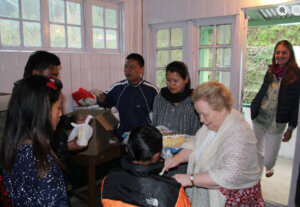
Nowadays, diabetes, dysentery and skin diseases are probably the most prevalent diseases. Hospitals and clinics are dotted around the district, but they are never enough to cope with the ever-growing population. The witch doctor is still to be found in the poorer villages.
The first car to arrive in Darjeeling was a Baby Austin, in 1925. Up till then, most plantations only had dirt tracks at a steep gradient, and travelling depended largely on horses, so the arrival of cars was a welcome addition. Roads improved and soon cars were no longer a novelty. Nowadays, local people complain that Darjeeling is overwhelmed with cars and it is difficult to find parking space.
Mount Everest
Darjeeling is proud of its association with early climbing expeditions which assembled in the town, and the many local Sherpas who took part. The members of the 1924 expedition, which ended so tragically, assembled over a period of many months at their hotel base. Mallory, in his spare time, enjoyed a game of billiards at the Planters Club. When the expedition was ready to depart, they did so in stages. Some of the climbers rode mules, and their first night was spent at the Peshoke Dak Bungalow on the way to the Teesta River, where they probably had the usual Dak Bungalow fare for dinner of roast chicken, potatoes and locally grown vegetables, followed by stewed fruit and custard.
During their stay they recorded their heights on a wall and for many years afterwards, visitors to Kalimpong stopped at the bungalow just to see the wall. (Regrettably, the wall no longer exists, as the Dak Bungalow was burned down during a recent local riot).
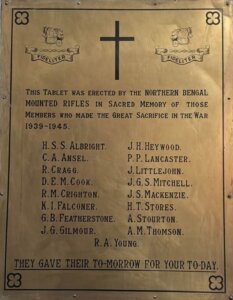
of the Northern Bengal Mounted
Rifles who ‘made the great sacrifice’
during WW2 (Photo: Gurpreet Singh Anand)
After a comfortable night, they trekked downhill to the Teesta River in steamy conditions through a dense forest of Teak and Sal trees. After crossing the river, they were on their way to the border town of Kalimpong, and Mount Everest.
World War II
When war broke out in 1939, tea planters and their assistants left to join the armed forces; many Nepalese joined the Brigade of Gurkhas. Most of the planters were members of the Northern Bengal Mounted Rifles, which was raised in 1878 to protect the Darjeeling residents. At independence in 1947 it was disbanded.
A plaque in St Andrew’s Church commemorates the 17 members who ‘made the great sacrifice’ in the War.
Senior managers stayed behind to supervise their tea gardens and gardens with absent managers and assistants. The tea factories worked overtime, sometimes through the night during the Monsoons to satisfy the ever-increasing demand for tea.
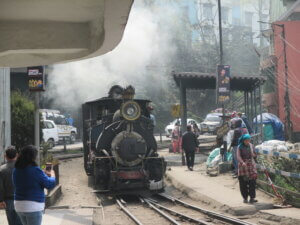
Darjeeling station (Photo: P Dean, 2024)
The 1881 Darjeeling Himalayan Railway, the 2’ gauge steam train affectionately known as the ‘Toy Train’, travels from Siliguri to Darjeeling. The route has many twists, double loops, zig-zags, no tunnels and breathtaking views.
During the war Darjeeling was crowded with troops on leave or convalescing after illness or wounds at the Eden Sanatorium. They travelled by overnight train from Sealdah station in Calcutta to Siliguri, and next morning after breakfast in the station restaurant, would depart for Darjeeling on the Toy Train for a journey of 7 hours, with stops at Kurseong and Ghoom.
Every hotel and boarding house was full from April to the end of October. Refugees from Burma helped to swell the numbers. At one stage there was water and food rationing.
The Gymkhana Club, with its excellent facilities, provided much of the town’s entertainment and the races at Lebong in May and October were very popular. The racecourse was the highest in the world and probably the most crooked in every sense of the word! Jockeys were local lads who raced Tibetan ponies.
Independence
When the war ended and independence was declared in 1947, Darjeeling took a deep breath and found new ways to continue as a leading and popular tourist centre. New venues for trekking in the hills were recced, white water river rafting on the Rungneet and the Teesta rivers and the introduction of local arts and craft centres and shops were some of the options. The first daily flight by Indian Airlines Dakota aircraft from Calcutta landed at Bagdogra Airport in 1952 – flying time was one hour – what a contrast to the early days!
On the 3rd of June 1953, Tensing Norgay Sherpa, a Sherpa porter from Darjeeling, and Sir Edmund Hillary were the first people to climb Mount Everest. There was much pride locally that a Sherpa had made it to the top. His return from a visit to London to meet the Queen was eagerly awaited. On his arrival in Darjeeling, there were wild scenes and several days of celebration.
In looking back to the past, one of the sights much looked forward to during the Winter months were the colourful Tibetan caravans travelling from Tibet with their families, dogs and mule trains laden with wool, silks and other goods. They would descend on Kalimpong and Darjeeling, heralded by the bells hanging around the animals’ necks. The flags fluttering over the mules indicated their passports to trade. The Tibetans were a picturesque people with colourful jewellery and glowing faces. The women rouged their cheeks with pigs’ blood and, like most hill people, were cheerful and invariably had beautiful white teeth and flashing smiles.
Unfortunately, after Tibet was taken over by the Chinese the caravans stopped.
Darjeeling has obviously changed since 1947. Many of the old buildings such as the Town Hall, the Everest Hotel and the lovely Victorian houses and bungalows with names like Honeysuckle Cottage, Kenilworth and Ivanhoe – and the gardens where once English flowers grew, now look like remnants of a bygone age, which of course is true. However, the Windamere Hotel is still there and it hasn’t changed over the years. It’s still a delightful, cosy, chintzy, old fashioned hotel with coal fires in the bedrooms and hot water bottles in the beds – not one, but two – one for each foot!
The old Hill Cart Cemetery, established in 1840, is in a bad way. This is where so many pioneers, settlers, planters and military are buried.
In spite of its recent problems and calls for autonomy, Darjeeling continues to be a successful tourist centre – colourful and cosmopolitan. There is now a growing awareness that Darjeeling’s past should be celebrated and the newly formed heritage group has already made changes. Recently the Gymkhana Club and Planters Club were renovated, a sure sign that more might be done in the future, which will be good for the Town.
Celia Brown
Ed Notes:
•Dak Bungalow Chicken: Click here for a recent Times of India article on this ‘classic Anglo-Indian dish’, including a recipe…
•Hill Cart Road Cemetery, Darjeeling: Click here to read about BACSA Chairman Paul Dean’s visit there in spring 2024. If you would like to become involved with a forthcoming BACSA project at this cemetery, please email Paul Dean (chairman@BACSA.org.uk) directly.
Rachel Magowan
***************************************************************************
(Suggestions for BACSA website news items, volunteering opportunities and diary entries, are always welcome – please send them to ‘comms@bacsa.org.uk’.)