
Photo: R Crump
Founded by Frederick Young in 1823, Mussoorie – occasionally vying with Simla and Ooty for the title ‘Queen of the Hill Stations’ – perches about 4,500’ above Dehradun, the capital of Uttarakhand, in the foothills of the Himalayas.
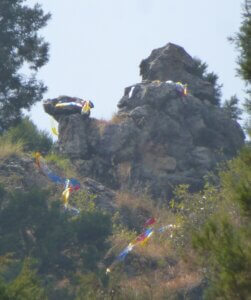
Mussoorie’s Camel’s Back Cemetery owes its memorable name to a curiously semi-bactrian shaped rock formation on the 1845 Camel’s Back Road, a peaceful 3km stretch between Library Chowk and Kulri Bazaar (via the notorious ‘Scandal Point’), overlooking forested slopes with spectacular views of snow-capped Himalayan peaks.
Originally entitled ‘Talking Tombstones’, the following article about Camel’s Back Cemetery by Ganesh Saili, the renowned Mussoorie-born writer and photographer, was recently published in the Garhwal Post:
“‘You have reached your destination!’ my GPS awakens me. Certainly not the pleasantest kind of thing to hear outside the lychgate of a cemetery. Let me warn the reader that we have reached the Camel’s Back Cemetery, where under a forest of cypress trees rest the bones of the minions of the empire.
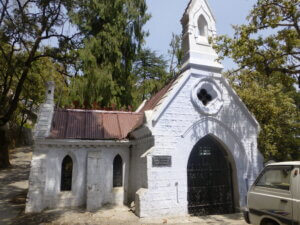
Photo: R Crump
In front of the caretaker’s shack is the impressive tomb of Sir Henry Bohle, dated 1851. He was a wealthy brewer, and is credited with starting the Bohle’s Brewery below Lyndale or Bansi estate – our first brush with beer.
Below the first bend in the road lies John A Hindmarsh, one of the hundred survivors from the Charge of the Light Brigade. On 16 April 1890 he was in his 59th year, when he was laid to rest by just two undertakers – Mr JC Fisher and Mr HE Hathaway. Both later declared that if only they had known, ‘they would have marshalled the whole station to pay final tribute to this gallant survivor’.
To this day, no one knows what Hindmarsh was doing in Mussoorie or where he lived.
The inscription on his grave reminds you that he was ‘One of the Six Hundred’. This reference is to the Crimean War of 1854, where at Balaclava, misinterpreting a command, the cream of the British cavalry charged to certain death to the boom of Russian guns. We have Tennyson’s immortal lines commemorating the moment:
‘Cannon to the right of them,
Cannon to the left of them,
Cannon behind them,
Volleyed and thundered;
Storm’d at with shot and shell,
While horse and hero fell,
They that had fought so well,
Came thro’ the jaws of Death,
Back from the mouth of Hell,
All that was left of them,
Left of the six hundred.’
Six years later, his wife, Amelia, came to rest beside him.
Who would dare creep past the grave of Gulabi, a girl from Mukba (a village along the Bhagirathi), who married Frederick E Wilson, also known as the Rajah of Hursil (he minted his own coins). She had been baptised as ‘Ruth Wilson’ to ensure that she would be buried on consecrated ground in 1899. Her husband had left this world a few years earlier, on 24 July 1883, aged 66 years and 7 months.
On a knoll facing the rising sun is buried John Lang, the Australian born author and barrister, who spent the last years of his life in Landour, and is remembered for his defence of the Rani of Jhansi in her case against the Doctrine of Lapse with the Company. She had rewarded him with: ‘A thousand guineas, besides such presents as shawls, dresses, ornaments’, and presented him with ‘a mosaic portrait of the Rani in precious stones.’
‘Who was this Hooper?’ Asks Professor Vidya Sagar Sharma, five years my senior in Allen Memorial School. ‘Why is our assembly hall named after him?’ he asks, not expecting an answer, as so far all Vidya’s efforts have elicited is a standard form letter stonewalling him: ‘Unfortunately records from the past are sketchy or often non-existent’.
I am intrigued. Usually I don’t take much interest in plaques bearing the names of those gone before. They reveal, if at all, so little. It is just not my kind of thing.
This time, while trawling the hill station’s history I find quite a few rare gems. Born in 1837, Reverend William Hooper was a man for all seasons, a Boden Sanskrit Scholar from Oxford University, who went on to become the Principal of Allahabad’s Divinity School. In his fifties, he arrived in the hill station and spent thirty-two years here, authoring his Hebrew-Hindi and Greek-Hindi dictionaries until he passed away in 1922, aged eighty-five years, having lived out his last years in the parsonage next to the church that is no longer a church, in a castle that is no longer a castle, and in a hill station that is just another hill.
Of course, there are twenty lakh graves just like these that are scattered across this subcontinent. They are permanent reminders that men and their matters perish.
These mountains, however, will remain forever”.
Click here to read Ganesh’s article in the Garhwal Post. Many thanks to Anabel Loyd, writer on South Asia, and Rosemary Raza, a long-standing member of BACSA (and for many years our much-appreciated Events Organiser), for sending us the details.
Ed Notes:
Ganesh Saili
 Ganesh Saili, who tells us that he lives on ‘Frederick Young’s potato patch’ at nearby Landour, has written over two dozen books. His Mussoorie Medley: Tales of Yesteryear, published in 2010 by Nyogi Books, is ‘full of lively anecdotes about the hill station’s history, people, eccentrics, scandals – everything that makes the place unique’.
Padma Shri Hugh Gantzer 1931-2026
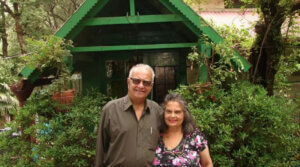
Photo: Indianexpress.com
Hugh Gantzer, who had been living at Mussoorie since childhood, became a Commander in the Indian Navy, and served as Judge Advocate of the Southern Naval Command.
After retiring in 1974, Hugh embarked on a joint travel-writing career with his wife Colleen, fulfilling a commission to write a book on Kerala for the India Tourism Development Corporation.
Over the next 50 years they co-authored over 30 books, numerous articles and documentaries.
A ‘fierce protector of the Himalayas’ (and a member of BACSA), Hugh served as a member of the Supreme Court-constituted monitoring committee to track environmental issues in the Doon Valley and Mussoorie.
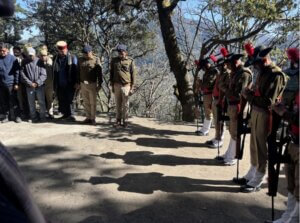
Photo: Ganesh Saili
In 2025 Hugh and Colleen were jointly awarded Padma Shri, one of India’s highest civilian honours, for their work in the field of travel journalism.
Hugh died in February 2026 and was buried, with due ceremony, in the family plot at Camel’s Back Cemetery. Click here to read an article by Sunil Sonker in the Garhwal Post describing the event.
Rachel Magowan
**************************************************************************************
(Suggestions for BACSA website news items, volunteering opportunities and diary entries, are always welcome – please send them to ‘comms@bacsa.org.uk’)