
Rosemarkie, Ross-shire – Dr Brydon’s final retreat
Jason Beckett, BACSA’s Cemetery Records Officer, recently came across these beautifully situated Scottish graves with fascinating Indian connections:
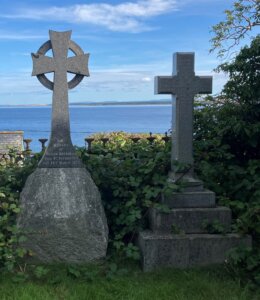
their children, next to the grave of Major General Donald Macintyre VC,
overlooking the Moray Firth (Photo: JB)
‘Tucked into the corner of a small Scottish churchyard, in the village of Rosemarkie, lie the graves of three people who experienced some of the most remarkable events in the history of British India.
Dr William Brydon, his wife Colina and her brother Major General Donald Macintyre VC lie side by side, overlooking the beautiful Moray Firth.
William Brydon was born on the 10 October 1811, coming from an old Scottish border family. He studied medicine at University College, London, and at the University of Edinburgh.
In 1835 he entered the service of the East India Company as an assistant surgeon. His first three years were served with both British and native regiments in the wild North-Western Provinces of India. During this time, he accompanied the then Governor General Lord Auckland to the court of Maharajah Ranjit Singh.
At the outbreak of the First Afghan war in 1839 William was posted to the 5th native infantry and stayed behind in Kabul whilst the main body of the invading army returned to India. As a result, he took part in one of the most disastrous episodes in British Military history, the terrible 90-mile retreat from Kabul to Jalalabad in the winter of 1842.
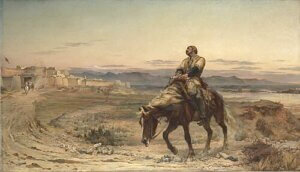
The retreating army consisted of 16,500 souls, both British and Indian including camp followers. Over the course of just a few days the army was brutally slaughtered until only a handful of survivors remained. Some were taken hostage whilst a few officers tried to reach the British garrison at Jalalabad. Only Brydon, despite suffering a sword wound to the head, succeeded. This moment is famously captured in Lady Butler’s painting The Remnants of an Army.
Brydon recovered from his wounds and resumed his duties as a regimental surgeon with the ‘Army of Retribution’under General Pollock, which briefly reoccupied Kabul in September 1842. He once again narrowly escaped death from an exploding enemy shell.
On 10 October 1844, in Bareilly, he married Colina Maxwell Macintyre, the daughter of an East India merchant. She accompanied him for at least part of his military service to Jalalabad, Afghanistan, where their daughter Charlotte was born in 1850. In total they were to have three sons and three daughters.
In 1849 William was promoted to surgeon and posted with the 40th native infantry and served in Burma.
In 1853 he returned home on sick leave for three years before returning once again to India.
In May 1857 William and Colina, together with their two children, were living in a bungalow in the army cantonment in Lucknow. William was attached to the 71st Native Infantry.
In 1857 the Indian Mutiny tore through northern India and the city of Lucknow found itself flung into the midst of this catastrophic event. The famous siege of the Lucknow Residency commenced in June, lasting until November of that year. The defence of the Residency by the small garrison, including civilians and their families became a Victorian legend.
Colina’s account of the Siege can be found in ‘The Lucknow Siege Diary of Mrs. C.M. Brydon’, which was published in 1978. It sets out how she managed to feed her children, nurse the wounded and sick and even keep watch at Grants bastion, one of the Residency’s main defensive positions. Somehow the Brydon family survived, despite many close shaves including William being severely wounded when a rifle bullet passed through his loins, injuring his lower spine.
William was appointed a Companion of the Order of the Bath in November 1858 in recognition of his service.
Worn out from campaigning he retired in 1859 and returned home with Colina and their children to Scotland where he became honorary surgeon to the 96th Highland Rifle Militia. He lived peacefully in Westfield House at Nigg, on the peninsula above Cromarty Firth and died in his bed on the 20 March 1873.
Colina moved to the small fishing village of Cromarty and lived there until her death at the age of 70, on the 15 December 1899.
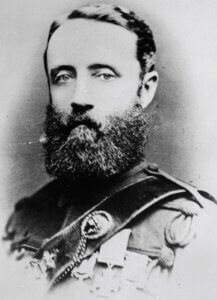
(IWM)
Colina’s brother Donald Macintyre was born in Kincraig, Scotland in 1831, the second son of Donald Macintyre and his wife, Margaret Mackenzie. He was educated at Addiscombe Military Seminary from 1848 to 1850.
He entered the Bengal Army on 14 June 1850. Joining the 1st Goorkhas (then known as the 66th Regiment Bengal Native Infantry), he served in several small campaigns on the North West Frontier.
In 1856 he served with them, under Sir Neville Bowles Chamberlain (1820-1902), in an expedition to the Kurram Valley, Afghanistan.
During the Indian Mutiny of 1857-1858, while raising what is now the 4th Gurkha Regiment, he was employed in protecting the hill tribes on the Kale Kumaon Frontier from the Rohilkhand rebels, and in maintaining order in the district.
It was for his service in the Lushai Expedition of 1872, that the now Major Macintyre was awarded the Victoria Cross. It recognised his valour for the following action which took place on the 4th of January that year.
The citation reads:
‘During the assault on the village of Lalgnoora on 4th January, MacIntyre was the first to lead the attack, and he reached the stockade first. Despite it being over eight feet high, he proceeded to climb over and disappeared into the flames and smoke of the burning village. The stockade was successfully attacked following the actions of Macintyre under heavy enemy fire’.
Donald was presented with his VC whilst serving in India later in the winter of 1872.
He last saw active service in the 2nd Afghan War of 1878-1880, where he commanded the 2nd Gurkhas with the Khyber Column, and took part in the expeditions to the Bazar Valley.
He finally retired from the Bengal Staff Corps on Christmas Eve 1880, with the rank of Major-General.
In addition to his outstanding military career, Donald was also a great traveller and fellow of the Royal Geographical Society. In 1889 he published an account of his experiences in Hindu Koh: Wanderings and Wild Sports on and beyond the Himalayas, available on www.archive.org.
He subsequently lived in Fortrose, Ross-shire where he died on 15 April 1903, aged 71, and was buried in Rosemarkie churchyard beside his sister Colina and her husband Dr Brydon, overlooking the beautiful Moray Firth.’
Jason Beckett
***************************************************************************************
(Suggestions for BACSA website news items, volunteering opportunities and diary entries, are always welcome – please send them to ‘comms@bacsa.org.uk’.)