
VJ Day and caring for the memorials of the Indian Army
With VJ-Day very much in everyone’s mind, Jason Beckett, BACSA’s new Cemetery Records Officer, has supplied this article about the Indian Army war memorials in South Asia:
This year’s VJ-Day marked the 80th anniversary of the surrender of Imperial Japan and the end of World War Two.
Commonwealth War Graves Commission
The Commonwealth army, which fought in the far east, has been called ‘the forgotten army‘. It endured some of the worst fighting and harshest conditions experienced in the war.
The Indian army made up a large percentage of the Commonwealth forces. By the end of the war, it had become the largest volunteer army in history. Men from Nepal, Madras, Bengal and Bombay fought side by side with the British army against the imperial Japanese army and won.
The Commonwealth War Graves Commission (CWGC) commemorates more than 87,000 Indian service people who died during the war. 18,000 are buried in its cemeteries and 68,000 more are commemorated on its memorials around the world.
They preserve the memory of men like Abdul Hafiz and Naik Fazl Din.
18-year-old Abdul Hafiz, who was born in the Punjab, led an attack during the Battle of Imphal; he was fatally wounded and posthumously awarded the VC. He is remembered at the Imphal Indian Army War Cemetery.
Naik Fazal Din was leading his section in an attack on a fortified Japanese bunker. He was ambushed and mortally wounded but still managed to take the bunker before succumbing to his wounds. He was awarded the VC and is remembered on the Rangoon Memorial.
The following are a few of the cemeteries and memorials which are cared for by the CWGC; they contain the remains of these brave men and women.
Alamein Memorial
The battles of El Alamein in 1942 marked a turning point in the war, where Britain and its allies achieved their first major success of the war.
11,000 casualties are commemorated on the Alamein memorial; 1,800 of these served with Indian forces. A further 600 Indian casualties are listed on the Alamein Cremation Memorial.
You can find out more about the Alamein Memorial here: Alamein Memorial
Kranji War Cemetery and the Singapore Memorial
The British defeat in Singapore marked one of the darkest days of the war. On the 15th February 1942 Singapore surrendered and 80,000 Commonwealth troops became prisoners of war.
The Singapore Memorial commemorates over 24,000 Commonwealth casualties, more than 12,000 of whom are Indian.
Some of them died during the defence of Malaya and Singapore, but most died while in captivity.
The Singapore Cremation Memorial commemorates almost 800 casualties, most of whom were Indian forces.
Find out more about the cemetery here: Kranji War Cemetery
Taukkyan War Cemetery & Rangoon Memorial
Taukkyan is a vast cemetery with almost 6,500 graves, They stand in rows around the Rangoon Memorial, which lists almost 27,000 missing war dead. 20,000 of these men served with the Indian forces.
The Taukkyan Cremation Memorial commemorates a further 1,000 World War Two casualties, largely Hindu and Sikh, whose remains were cremated in accordance with their religions.
Most of these men were casualties of the campaign in Burma.
You can find out more about Taukkyan Cemetery here: Taukkyan War Cemetery
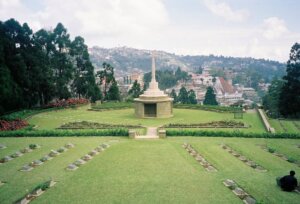
Imphal Indian Army War Cemetery
The battles of Imphal and Kohima are some of the greatest military victories ever achieved by the British and Indian armies. Defeating the Japanese and turning the tide in Burma led to victory in the East.
Imphal cemetery contains 1,600 Commonwealth burials from the Second World War.
The cemetery also contains the Imphal Cremation Memorial which commemorates the 868 Hindu and Sikh soldiers and airmen killed in the battle for Imphal whose remains were cremated.
To learn more about Imphal War Cemetery click here: Imphal War Cemetery
Kohima War Cemetery
The Kohima War Cemetery stands on the site of the battlefield. It contains the graves of 1,420 Commonwealth soldiers.
Within the cemetery stands the Kohima Cremation Memorial, which commemorates the 917 Hindu and Sikh soldiers whose remains were cremated in accordance with their faith.
To find out more about Kohima Cemetery click here: Kohima War Cemetery
The Indian Army was instrumental in the defeat of Imperial Japan. Its men and women paid the ultimate price for the victory which we remember on VJ day.
You can find out more about how the Commonwealth War Graves Commission preserves the memory of the 160,000 Indian casualties of both World Wars by following this link: How to Find and Visit Indian War Dead from the World Wars
Jason Beckett, Cemetery Records Officer